 +86 183 6377 3366
Leave Your Message
-
Contact Phone
-
 Contact Email
Choosing the best Beer Glass Bottle is not simply a matter of appearance. The right bottle protects flavor, supports safe carbonation, and communicates the beer’s character before the first sip. Brewers must examine glass color, bottle volume, neck finish, closure compatibility, pressure resistance, weight, and transport conditions.
Industry data shows why this decision deserves careful attention. The Brewers Association reported that U.S. craft beer retail sales reached approximately $28.9 billion in 2023. Packaging remains a visible part of that value. Meanwhile, the European Container Glass Federation reports that Europe’s glass packaging recycling rate is around 80%. These figures highlight two practical concerns: market presentation and material recovery. Glass can be recycled repeatedly, but collection systems and bottle design still influence its real environmental performance.
Scott DeFife, President and CEO of the Glass Packaging Institute, has described glass with a simple principle: “Glass is infinitely recyclable.” That statement is useful, but incomplete. A recyclable bottle can still create unnecessary emissions if it is excessively heavy or shipped across long distances. No bottle is perfect.
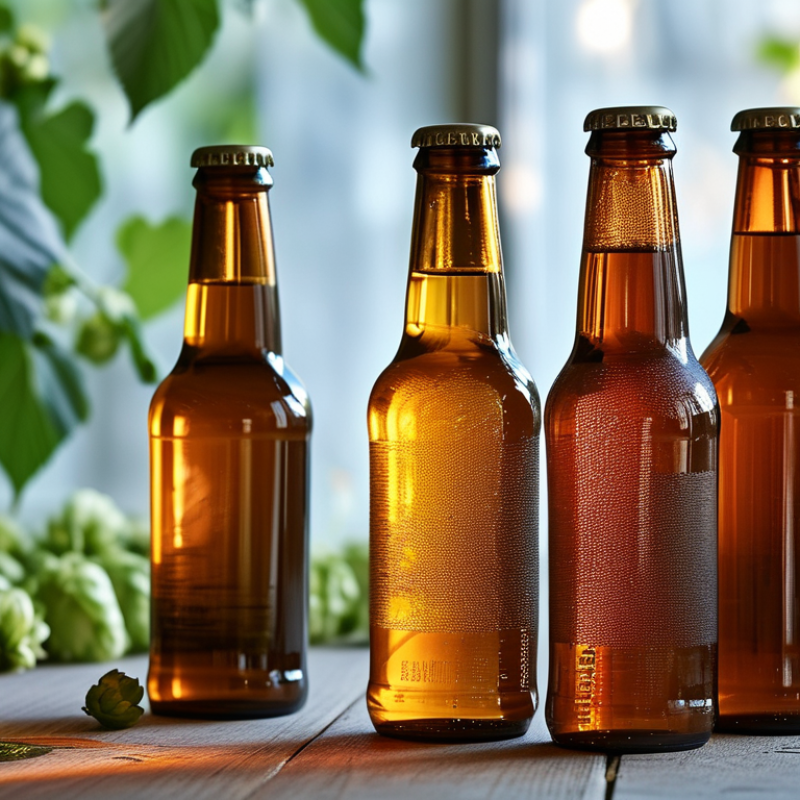
Amber glass usually offers stronger protection from ultraviolet light, which can damage delicate hop aromas. Clear glass creates visual appeal, but it requires careful beer selection and storage. A returnable Beer Glass Bottle may reduce packaging waste in suitable distribution systems, while a lightweight one-way bottle may work better for distant markets. The best choice depends on beer chemistry, filling equipment, shelf life, brand positioning, and local recycling infrastructure. A beautiful bottle that fails during transport is not a successful package.
How to Choose the Best Beer Glass Bottle?
Understanding Beer Bottle Glass Types and Their Key Differences
Beer bottle glass is not simply clear or colored. Each type affects light protection, appearance, weight, and handling. Amber glass blocks most ultraviolet light, helping protect hop aroma and prevent unwanted flavor changes. Green glass offers moderate protection but may need careful storage. Clear glass displays color beautifully, though it allows more light to reach the beer. This works better for less light-sensitive recipes. Flint glass feels clean and modern. However, appearance should never replace practical testing.
Tips: Check the bottle’s pressure rating, neck finish, and wall thickness. Hold a sample under bright light. Look for tiny bubbles, scratches, or uneven glass. These details can signal inconsistent production. Ask for food-contact documentation and migration test results from the supplier. A reliable supplier should explain these documents clearly, not avoid them.
In packaging inspections, I compare filled bottles after transport simulation and temperature changes. A slightly heavier bottle may resist impact better, but it also increases shipping weight. Returnable glass can reduce repeated packaging waste, yet it requires stronger inspection systems. One-way glass is often lighter, but damage may occur more easily during handling. Crown closures need a precise finish for a secure seal. I once focused too much on color and overlooked grip comfort; that was a useful mistake. The best choice depends on the beer, filling process, storage conditions, and customer experience.
| Glass Type | Typical Appearance | Main Composition or Feature | UV and Light Protection | Thermal Shock Resistance | Common Beer-Bottle Uses | Key Advantages and Limitations |
|---|---|---|---|---|---|---|
| Amber Soda-Lime Glass | Brown or amber | Standard soda-lime glass colored with iron, sulfur, and carbon compounds | Excellent | Moderate | Light-sensitive beers, long-storage products, and most packaged beer styles | Provides the strongest practical protection against ultraviolet and short-wavelength visible light. It is widely suitable for carbonated beer, but it can still break if exposed to rapid temperature changes. |
| Green Soda-Lime Glass | Light to dark green | Soda-lime glass containing color-producing metal oxides | Low to moderate | Moderate | Beers where traditional appearance and shelf presentation are important | Offers better light screening than clear glass but less than amber glass. Beer should be stored away from direct sunlight because green glass does not fully prevent light-struck flavors. |
| Clear Flint Soda-Lime Glass | Transparent or colorless | Low-color soda-lime glass designed for high transparency | Minimal | Moderate | Short-term sales, refrigerated distribution, specialty presentation, and products protected by opaque packaging | Shows the beer’s color clearly and is generally economical. It provides little protection from light, so storage conditions and secondary packaging become especially important. |
| Cobalt or Other Colored Soda-Lime Glass | Blue, black, or other decorative colors | Soda-lime glass modified with pigments or metal oxides | Varies by color and thickness | Moderate | Limited-release packaging, gift products, and visual differentiation | Can improve shelf appearance and may reduce some light transmission, but protection is not automatically equivalent to amber glass. Actual light transmission should be verified with the bottle supplier. |
| Borosilicate Glass | Usually clear; can also be colored | Glass containing a significant amount of boron oxide, giving it a lower thermal expansion rate | Depends mainly on color and coatings | High | Specialty containers, laboratory-style packaging, and applications requiring repeated temperature changes | Handles rapid temperature changes better than ordinary soda-lime glass. It is typically more expensive and less common for standard beer bottles, so pressure rating and closure compatibility must be confirmed. |
| Heat-Strengthened Soda-Lime Glass | Usually amber, green, or clear | Ordinary soda-lime glass treated with controlled heating and cooling | Depends on the bottle color | Higher than untreated glass | Reusable or refillable bottle systems and applications exposed to repeated washing cycles | Offers improved resistance to thermal stress and mechanical handling. It is not the same as fully tempered glass, and the bottle still needs a suitable design for internal carbonation pressure. |
| Tempered Soda-Lime Glass | Usually clear or colored | Soda-lime glass thermally treated to create compressive surface stress | Depends on color and thickness | High | Special-purpose containers and products requiring additional resistance to thermal and mechanical stress | Provides greater strength and thermal-shock resistance than untreated glass. When broken, it may fracture into smaller pieces, but the container must still be specifically designed and tested for beer pressure. |
| Recycled-Content Soda-Lime Glass | Color depends on the glass mixture | Soda-lime glass manufactured with a proportion of recovered glass, known as cullet | Depends on the final color | Comparable to the same base glass | Standard beer bottles where material-efficiency goals are part of the packaging specification | Using cullet can reduce raw-material demand and melting energy. Performance depends on the final formulation, manufacturing quality, wall thickness, and bottle design rather than recycled content alone. |