The implementation of PPWR has completely changed the competitive landscape of the
Glass Bottle industry, and its core requirements have restructured enterprises' production and operation strategies from three dimensions:
On the
material and design front, the new regulation clearly restricts the use of hazardous substances in packaging, sets strict threshold requirements
for per- and polyfluorinated alkyl substances (PFAS), and mandates "lightweight design" to prohibit unnecessary packaging redundancy. This requirement directly addresses the pain point of traditional glass bottles being "heavy and material-intensive" - data shows that the average person in the EU generates 186.5 kg of packaging waste annually, nearly half of which comes from packaging in marine litter, and the transportation carbon emissions of glass packaging have long accounted for more than 35% of the industry's carbon footprint.
On the
circular system front, PPWR for the first time incorporates "reuse system construction" into mandatory provisions, requiring catering enterprises to provide consumers
with the option of bringing their own containers without additional charges, and setting minimum proportion targets for the use of recycled materials in packaging for 2030 and 2040. This policy has directly activated the reusable glass bottle market; according to the European Commission's forecast, by 2030, the market share of reusable glass packaging in Europe will increase from the current 12% to more than 30%.
On the extended responsibility front, the new regulation establishes a full life cycle traceability system, requiring enterprises to take responsibility throughout the process from design, production to waste disposal, making "easy recycling and high recycling rate" the core threshold for glass packaging to enter the European market.

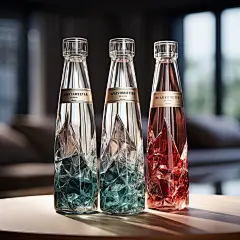
In response to the stringent requirements of PPWR, the thermally hardened lightweight reusable glass bottle developed by European glass packaging giant Vetropack after nearly a decade of research has become a benchmark for industry technological upgrading. This 0.33-liter standard bottle, launched in Austria in 2024, has won the WorldStar Award twice with three innovative advantages and won the "Sustainability" special bronze award at the 2025 Milan I PACK-IMA exhibition.
Its core innovation lies in the combination of thermal hardening technology and lightweight design. Through proprietary technology, Vetropack has successfully reduced the weight of the glass bottle by 30% while achieving higher structural stability, increasing the number of recyclable uses per bottle by 20% compared with traditional products. This breakthrough directly solves the contradiction between lightweight and durability - traditional lightweight glass bottles usually have a recycling count of no more than 15 times due to insufficient impact resistance, while this product has achieved an average recycling count of 28 times in practical applications in the beer industry.
In terms of full-chain collaborative optimization, Vetropack has collaborated with partners such as the Austrian Logistics Association for Reusable Packaging and the Austrian Brewers' Association to achieve in-depth coordination of bottle, crate and pallet design. This system-level optimization has reduced carbon emissions in the logistics link by 40%, perfectly aligning with PPWR's requirements for full-life cycle emission reduction. Daniel Egger, Head of Innovation at Vetropack, stated: "This technology not only saves resources but also achieves the dual benefits of CO₂ emission reduction and cost savings in the beer market, confirming the commercial value of sustainable design."
Currently, this product has become the preferred packaging solution for industries such as beer and juice in Europe, and its successful commercialization proves that the combination of lightweight and high recyclability can meet both policy compliance and corporate profitability needs.
Vetropack's practice and the implementation of PPWR together reveal the future direction of the global glass bottle industry, providing enterprises in different markets with a replicable transformation experience:
Policy response requires advance layout: Enterprises should transform policy compliance into innovation opportunities. Before PPWR came into force, Vetropack had completed technical reserves, allowing it to quickly seize market opportunities after the new regulation was implemented. For enterprises in emerging markets, aligning with international environmental standards in advance can avoid falling into the cost trap of "passive compliance".
Technological innovation focuses on system value: Lightweight should not be limited to the bottle itself but extended to the entire chain including logistics and recycling. Vetropack's success lies in building a closed-loop system of "product + logistics + recycling", and this systematic thinking maximizes the emission reduction benefits of technological innovation.
Circular model reconstructs business logic: Reusability is changing from an "environmental option" to a "business necessity". As PPWR promotes the improvement of reuse systems, the "circular value" of glass bottles will increase significantly - it is estimated that a lightweight glass bottle that can be recycled 50 times has a full-life cycle cost 62% lower than that of a disposable glass bottle and 28% lower than that of a plastic bottle.
 +86 183 6377 3366